What We Killed Thursday

Erythrina, or coral trees, are well known for their spectacular flowers and are often grown ornamentally.  They’re also very important in the ecosystems they belong to.  Their leaves are food for caterpillars of many moth and butterfly species.  Their nectar and seeds sustain numerous bird species, including a number of hummingbirds.  Coral trees are also medically and culturally important  to people.

Erythrina crista-galli

Erythrina crista-galli

While members of this genus are found throughout the tropics and subtropics, Erythrina schliebenii is no longer found anywhere.  E. schliebenii was described in the 1930s from a specimen found in Tanzania.  It was seen again in 1984 between Lindi and Masasi, Tanzania.  Like many coral trees, it had bright red flowers.  This herbarium sheet from the 30s is all we have left of E. schliebenii – it was declared extinct by the IUCN in 1994.

Erythrina schliebenii

Erythrina schliebenii

There might not be much you can do to directly help protect species in Tanzania, but you can help protect fragile Arctic ecosystems.  There’s ANOTHER bill trying to open up the Arctic Refuge for drilling.  Write a letter.


Patagonian Petunias

Solanaceae Petunia patagonica by jardin.lautaret

Solanaceae Petunia patagonica by jardin.lautaret

This is probably not quite like any petunia you’ve seen before.  Patagonia seems to have such interesting plants.  Perhaps I’ll go botanizing there someday.

Foundation

I’ve had Isaac Asimov’s Foundation series recommended to me a million and one times and I finally got around to reading the first book in the series, Foundation.

The premise of the series is interesting – Psychohistory is a science that combines statistics and psychology to predict what large populations of people will do.  A group of psychohistorians living at the end of an empire make a plan that they hope will cause a new empire to form after just a thousand years or so, instead of the usual tens of thousands of years later, thus preventing millenia of war, etc.  Key to their plan is the Foundation, a planet the psychohistorians settled and tasked with keeping all the knowledge that humanity had gained during the last empire.  Foundation will be a key player in a number of political crises that the psychohistorians have predicted.  If Foundation plays its cards right, the psychohistorians’ plan will succeed and a new empire will form in a relatively short amount of time, bringing stability and prosperity.  If it doesn’t, it’ll take a whole lot longer for a new empire to form.

Sounds pretty cool, right?  It wasn’t.  I won’t be reading the rest of the series – I hated Foundation.  There are three major political crises in Foundation.  In each of them, a cocky, rebellious guy outsmarts the current Foundation rulers and averts disaster and then spends pages and pages telling all the other characters how smart he is and being an ass to his enemies.  I felt like Asimov had written one political crisis section and then changed the names and a few details.  The characters weren’t likable or even particularly interesting – I had a hard time telling them apart.  Reading Foundation was like watching frat boys trying to prove their manliness to each other.

Another thing that got to me – women basically don’t exist in this book.  One character referred to a daughter that he hoped had died rather than be captured.  The wife of one ruler was in 2 or 3 scenes, but she served simply as an extension of her father.  Those were the only two women I noticed in the entire book, which had an extensive cast of male characters.  I know Asimov wrote these in the 50s and he was a “product of his generation,” blah blah blah, but it’s hard for me to get into a story when there is no character at all like me.  Plus, it makes me mad that women are so incredibly inconsequential in his vision of the future.

What I’ve Noticed

Lesbian stereotypes are so much fun to play with.

The conservatives on the Supreme Court think pregnancy discrimination is ok.  I don’t get it – shouldn’t they consider it double discrimination?

Fathers with daughters often become more liberal. I’d say that’s good evidence that current conservative policies hurt women.  Of course, you could also say that spending too much time with women makes men too “soft.”

Choosing Sotomayor was a pretty good political move.

A memorial day thought that made me cry.

PZ on the horrific crimes of the Irish Catholic Church: Can we stop equating religion and morality now? They never seem to have much to do with one another.

This woman deserves to go to jail for murder.  And maybe her pastor, too.

Race and terrorism.

The Sri Lankan government has been leveling all sorts of terrible accusations against the Tamil Tigers.  Looks like the pot was calling the kettle black.

How to get straight couples to understand why the right to marry is important.

The Christian god isn’t the only real god according to the Bible.  He just thinks he’s better.

Delara Darabi – if there had been more news coverage in the West, she may have lived.

To keep you up at night.

I think The Onion does a good job summarizing my views so far on the Obama Presidency:  Obama Revises Campaign Promise Of ‘Change’ To ‘Relatively Minor Readjustments In Certain Favorable Policy Areas’

Berry Go Round #17

Welcome to the 17th edition of Berry Go Round!  Before you get started here, you may want to check out the 16th edition hosted at Quiche Moraine.  It’s full of exciting posts on mutualism.

GrannyJs knitted leaf. ID, anyone?

GrannyJ's "knitted leaf." ID, anyone?

GrannyJ’s A garland of leaves at Walking Prescott, is a beautifully illustrated post comparing the shapes and colors of a variety of leaves.  As she says, leaves are “quite as interesting as flowers, though not nearly as gaudy.”  My personal favorite of her many examples is a leaf that looks like it’s been knitted!

In addition to some garden plants, she posted quite a few shots of natives.  One of the features many of them have in common are tough, evergreen leaves.  If you want to have leaves that stick around in the desert, they should be tough, filled with some nasty chemicals, and good at conserving water.

Jeremy Yoder presents Seed dispersal by ants: A lousy way to travel, a good way to diversify posted at Denim and Tweed, saying, “Myrmecochory, or seed dispersal by ants, is an evolutionary “key innovation” that helps generate new species – not because it’s such a great way to disperse seeds, but because it actually isn’t.”

I find ant-plant mutalisms fascinating.  If you liked Jeremy’s post as much as I did, you may also be interested in this Science article about ants, Acacia, and large mammal herbivores.  Ants protect Acacia from large mammal herbivores and are rewarded with nectar. When the mammals were kept away from the plants for a number of years, the Acacia stopped providing so much nectar for the ants.  This seems like a good thing to do – why waste resources feeding the ants if you don’t need them to project you anymore?  However, the lack of nectar caused the ants to lose their competitive edge against stem boring beetles which did all kinds of damage to the trees and even caused many of them to die.
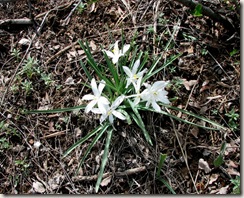
Sand Lily

Sand Lily

Sally at Foothills Fancies writes about a trip to Lair o’ the Bear and despite the rather scary title – Live at the Bear’s Lair – the post is full of flowers, not carnivores.  This Sand Lily is just one of the lovely wildflowers she highlights, sharing this interesting little tidbit:

In these spring plants, the ovary is below ground level, so the pollen tube has a long way to go to reach it. The seeds mature underground and later get pushed out onto the surface where they can germinate.

While it sounds like Sally had a great trip, she was disappointed at not getting any good pictures of Pasqueflowers (Pulsatilla patens). Lucky for us, Priscilla Stuckey of this lively earth presents us with both lovely photos of Pasqueflowers and their strategy for fending off snow and ice along the Front Range of Colorado in Pasqueflower’s risky business.

Pasqueflower

Pasqueflower

Janet Creamer from Midwest Native Plants, Gardens, and Wildlife has another wildflower-filled post for us – Flowers and such from Boch Hollow.  When I saw her photo of Running Buffalo Clover and learned it was endangered, I got a little nervous – wasn’t that the plant I spent half my childhood pulling out of our flower gardens? I was relieved to find out that it was not!  The weed I remembered is White Clover, which is in no way endangered.

Emily at No seeds, no fruits, no flowers: no problem shares her first field trip of the season in First ferns.

Dryopteris goldiana fiddleheads

Dryopteris goldiana fiddleheads

She has several stunning fern photos featured, including these Dryopteris goldiana fiddleheads.  They’re ENORMOUS and kind of look like some sort of larvae to me. Luckily, they don’t squirm and have such nice colors, so I’m not disgusted.  When I went to Lotusland last year, I was impressed with the fiddleheads on one of the ferns I saw there.  They were as large as my fist!

Martin Nuñez at The EEB and flow blogs a recent paper that shows that Artemisia tridentata recognizes itself.  How cool is that?

Last but not least, I’ve got some ID puzzles for you all!  I met David while I was teaching English in China.  He’s currently teaching in Suzhou, which is famous for its gardens.  The following photos were taken in The Lingering Garden and he wants to know what these plants are.  He didn’t get shots of the leaves or growth habit, which makes this a bit more of a challenge.

Click on any of the photos for a larger image.  Also, I highly recommend browsing the rest of David’s flickr photos – they’re wonderful!

Unknown #1

Unknown #1

Unknown #2

Unknown #2

david3

If you’d like to stick around for a bit, you might be interested in my series on extinct plants or the trip I took with my university’s botany club last spring.

That’s the end of Berry Go Round #17! Use the carnival submission form to send in posts for the next Berry Go Round. I’m not sure who’s hosting the June edition, but you can always check the blog carnival index page. which will be held at Foothills Fancies.